
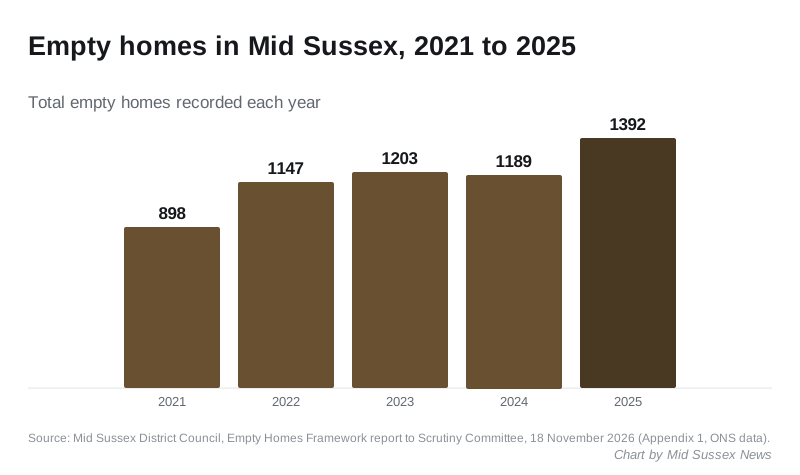
Mid Sussex had 1,392 empty homes in 2025, up from 898 in 2021 and the sharpest rise of its neighbours. Councillors look at a plan to fill them on 18 November.
The number of empty homes in Mid Sussex rose by 55% in four years, from 898 in 2021 to 1,392 in 2025. That is the steepest rise of any of the neighbouring districts the council compared itself with. Councillors will look at a new plan to bring empty homes back into use on Wednesday 18 November.
The figures are in a report to the council’s Scrutiny Committee for People and Communities. It presents a draft Empty Homes Framework for 2026 to 2030, which the committee is asked to recommend to full council in December.
How Mid Sussex compares
The report sets Mid Sussex beside three neighbours. Its table uses ONS data, with each year’s figure a snapshot taken on one day.
| Council area | 2021 | 2025 | Change |
|---|---|---|---|
| Mid Sussex | 898 | 1,392 | up 55% |
| Wealden | 980 | 1,189 | up 21% |
| Horsham | 646 | 786 | up 22% |
| Reigate and Banstead | 1,076 | 1,213 | up 13% |
The rise needs some context. In 2025, 2% of the district’s 70,807 homes stood empty. That is still a little below the figure for England as a whole, which was 2.1%, according to the same table.
What is empty now
Council tax records counted 1,318 empty properties in Mid Sussex in September 2026. This is a different count from the yearly figures above, so the two should not be compared directly. The draft framework splits them into four groups:
- 351 long-term empty homes
- 379 homes paying the empty homes premium
- 212 second homes
- 376 empty homes exempt from council tax
Second homes are not the target. Leaving them out gives 1,106 homes that have stood empty for six months or more, including 45 owned by housing associations. The framework says that number is roughly a third of the number of families on the council’s housing register.
What the council plans to do
The framework sets out five aims. In short, the council would:
- keep an accurate register of every empty home
- raise awareness and encourage residents to report empty homes
- give owners advice and support first
- score each property red, amber or green, so the most harmful cases get attention first
- collect the council tax premiums and debts owed on empty homes
Enforcement is the last resort. The options the report lists are empty dwelling management orders, enforced sales and compulsory purchase orders, used only where owners do not engage.
Officers are already working on problem properties. The report says one empty home is close to an enforced sale. It has been served a notice because its condition harms the area, and it owes substantial council tax. In another case, officers helped a family bring a home held up by probate back into use without enforcement.
A dedicated Empty Homes Officer would run the work. The report says this is an existing post that has been held vacant until the framework was ready, so it adds no cost. The framework itself cost £1,495 to produce, paid from existing budgets. A target for how many homes to bring back into use will be considered after its first year.
What it means for you
If you own an empty home, the bill rises the longer it stays empty. Since 1 April 2025, Mid Sussex has charged an empty homes premium that reaches double the normal council tax after one year, three times after five years and four times after ten. The framework says the council can also write a letter that lets owners of homes empty for more than two years pay a reduced rate of VAT on some renovation work.
If an empty home near you is causing problems, the framework says residents will be encouraged to report empty homes and given advice on the signs to look for. It has not yet published how to report one.
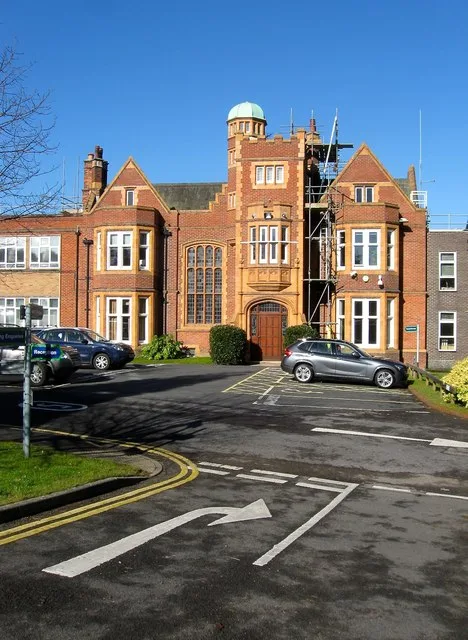
The Scrutiny Committee meets at 7pm on Wednesday 18 November in the Council Chamber at Oaklands, Haywards Heath. The agenda is on the council’s website, and the meeting is open to the public.
Have your say