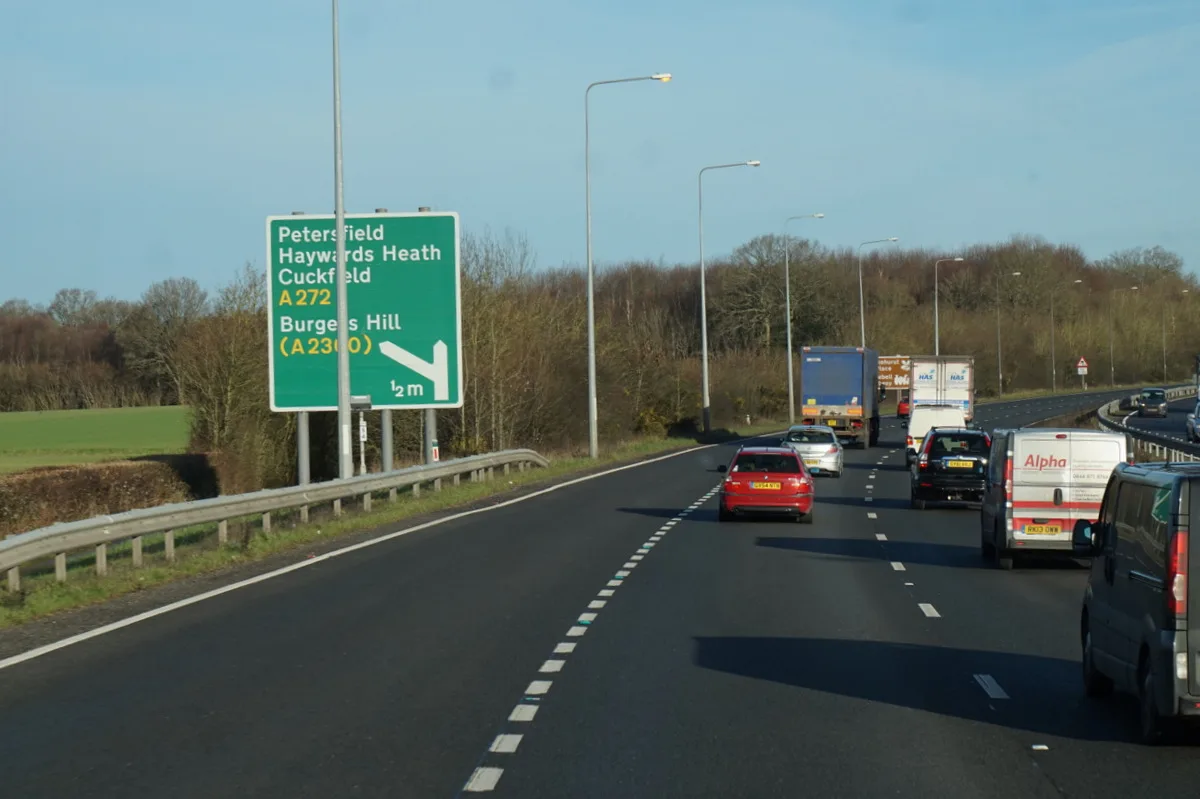

The round-the-clock 50mph on the northbound A23 at Dale Hill is now in force, and Heath Road in Haywards Heath stays shut until 2 October. Checked 22 September.
The A23 scheme at Dale Hill is now on the ground. National Highways’ order came into force on 19 September and the work was due to start on or after Monday 21 September. The 24 hour 50mph limit on the northbound carriageway applies from that point until the job is finished, which is expected to take about two months.
In Haywards Heath, Heath Road stays shut until 2 October. Farlington Avenue is closed in moving sections until 13 November.
The overnight closure of Turners Hill Road in Worth has one night left. The order expires on 23 September.
This page tracks what is actually shut in Mid Sussex and what is coming next, on the roads, the footpaths and the railway. It was last checked against the sources on 22 September 2026.
What is closed right now
These are temporary traffic regulation orders West Sussex County Council has made, so they are decisions rather than intentions. They are published as statutory notices on the Public Notice Portal.
| Road or path | Extent | Closed until | Reason |
|---|---|---|---|
| Heath Road, Haywards Heath | The Broadway to the Health Centre entrance | 2 October | Watermains replacement |
| Farlington Avenue, Haywards Heath | Entire length, in short sections | 13 November | Watermains replacement |
| Turners Hill Road and Wallage Lane, Worth | Hazelhurst Drive to 70m east of Wallage Lane | 23 September, nights only | Highway improvement |
| Footpath 10-1Ba, Balcombe | Haywards Heath Road to London Road (B2036) | 28 February 2027 | Railway embankment maintenance |
| Footpath 21cEG, East Grinstead | Harwoods Lane to Bridleway BW19cEG | Late January 2027 | Unsafe footbridge |
Heath Road is a made order. The county council’s notice of 3 September confirms the order runs from 7 September to 2 October, ref TTRO-2835-MM. Access to properties is maintained. That leaves ten days of it.
Turners Hill Road ends this week. The county council’s notice of 10 September gives the order as running from 15 to 23 September, closed 8pm to 6am, moving along the road in short sections and taking Wallage Lane with it for 100m north of the junction. Ref TTRO-2759-MM.
Two closures we listed last week have now ended and have been removed: Calluna Drive in Copthorne, which expired on 19 September, and the A264 Tough Mudder restrictions at Colgate, which applied only to the weekend of 19 and 20 September.
Access to properties on Farlington Avenue is being maintained, and the road is closed in short sections as the work moves along it. Its notice has rolled off the Public Notice Portal’s live listing, as has the East Grinstead footpath notice, so we could not re-read either today. Treat both end dates as the original orders’, not as fresh confirmations. On the East Grinstead footbridge the county council stated plainly that no alternative route is available using the rights of way network while it is out.
One closure remains an intention rather than a decision. Scamps Hill in Lindfield Rural, from 120m west of Sage Avenue westwards for 70m, was notified for 1 September to 2 October for culvert repairs, ref TTRO-2753-MM. It was published as a notice of intent in the county’s notice of 13 August and no later notice has appeared confirming it. Look for signs on site.
The A23 at Dale Hill: what the 50mph actually covers
This is the biggest thing on the district’s roads this autumn, and it will not appear on any county roadworks list, because the A23 belongs to National Highways.
The made order of 11 September, ref NH/SE/2026/A23/55, covers junction realignment work at Dale Hill Junction (A281), the turning for Poynings and Devil’s Dyke south of Pyecombe. From the order itself:
- The work is expected to last about two months, starting on or after Monday 21 September.
- The order came into force on 19 September and can run for up to eighteen months, ceasing when the work is complete.
- A 24 hour 50mph limit on the northbound A23, from about 600m south of the centreline of Pangdene Farm overbridge to about 60m east of the Dale Hill Junction (A281) overbridge.
- Overnight closures, 8pm to 6am, of the A23 between Mill Road roundabout and Dale Hill Junction, and of all roads leading to and from that length.
- The roads to and from the northbound A23 at Dale Hill Junction close for 24 hours, not just overnight.
- All lay-bys and bus stops alongside that stretch close for 24 hours.
- The shared use cycle track from Pyecombe street footbridge to West Road roundabout closes overnight, as does the road to the eastbound A27 at Devil’s Dyke interchange (A2038).
- Diversions use the A23, A24, A27, A259, A272 and A283.
One thing changed between the proposal and the order, and it matters if your vehicle is wide. The notice of 27 August proposed “a 24-hour width restriction of 3.25 metres in lane 1 and 3.0 metres in lane 2”. The made order instead imposes “a 24-hour width restriction of 2.3 metres in lane 2”, and sets no limit on lane 1. Both cover the same stretch of northbound carriageway, from about 240m north of Pangdene Farm overbridge to about 990m west of South Downs Way overbridge.
The made order is the operative document. A 2.3m limit is considerably tighter than the 3.0m that was proposed, and it is narrower than many vans are wide once mirrors are counted. We have not seen an explanation for the change published anywhere, and the notice does not give one.
A round the clock 50mph limit and a restricted northbound carriageway, held for two months through the autumn, is the sort of thing that reshapes a Brighton commute.
A23 and M23 nights, Monday 21 to Sunday 27 September
The A23 and M23 never appear on county roadworks listings. These come from the National Highways 7 day closure report, the edition covering Monday 21 to Sunday 27 September, downloaded today.
| Night | Closure |
|---|---|
| Every night, 21 to 27 Sep, 8pm to 6am | A23 northbound Dale Hill exit slip, for the junction realignment work above |
| Mon 21 to Fri 25 Sep, 9pm to 6am | A23 Pease Pottage roundabout, south west section, no access to the A264, for M23 junction 11 survey works |
| Mon 21 Sep, 8pm to 6am | A23 southbound entry and exit slips, Haywards Heath to Hickstead, maintenance |
| Mon 21, Tue 22, Thu 24, Fri 25 Sep, 9pm to 6am | A23 eastbound London Road exit slip, on the Gatwick approach, street lighting |
| Tue 22 to Thu 24 Sep, 10pm to 5.30am | M23 southbound junction 8, carriageway closure between the slip roads, plus a lane closure from junction 7, for gantry repairs |
| Thu 24 and Fri 25 Sep, 8pm to 6am | A23 southbound Hickstead entry and exit slips, electrical works |
| Fri 25 Sep, 11pm to 5.30am | M23 southbound junction 8 to M25 junction 7 link roads, both clockwise and anti-clockwise, gantry repair |
Two things are worth pulling out of that table.
The Dale Hill northbound exit slip is the one closure that runs every single night, Saturday and Sunday included, right through to 28 September. That is the two month scheme showing on the ground.
The Pease Pottage closure has changed shape since last week. It now runs Monday to Friday nights only and stops after 25 September, rather than every night including the weekend. It still takes out the link to the A264, which is the Horsham and Crawley road.
National Highways reissues this report every day, so check it again if you are travelling late in the week.
East Grinstead parking permits go up on 1 October, and the price is still not published
Buried at the foot of the county council’s 10 September notice is a change that has nothing to do with roadworks and will cost some East Grinstead residents money.
West Sussex County Council is varying the charges in the Second Schedule of its Mid Sussex District parking consolidation order, so that permit charges in the East Grinstead Controlled Parking Zone rise from 1 October 2026. It does this under section 46A of the Road Traffic Regulation Act 1984, which needs a newspaper notice and nothing else. There is no consultation and no route to object.
The notice does not print the new figures. It says “PLEASE DOWNLOAD PDF TO VIEW NEW CHARGES”, and no PDF is attached to the notice. We checked again today, nine days before the rise, and there is still no rate card for East Grinstead anywhere we can find. The council’s own on-street parking charges PDF, linked from its permit page, still shows the current prices.
The equivalent notice for Horsham does carry its rate card, which is how we know the scale of the increase the county is applying elsewhere. The Horsham notice of the same date has a PDF attached with old and new figures side by side. In the Horsham all-day zone, a first resident permit goes from £63 to £68 for twelve months, a subsequent resident permit from £126 to £136, and a non-resident permit from £380 to £410. Visitor books of ten go from £6 to £7, and the daily charge for suspending a permit bay from £15 to £20.
East Grinstead’s current charges match Horsham’s old ones almost exactly: £63, £126 and £380 for the same three permits. So an increase of that order looks likely here too. We are not reporting it as fact, because the county has not published the East Grinstead figures, and a notice that tells residents to download a PDF that does not exist is not a proper publication of a price rise.
East Grinstead is the only part of Mid Sussex with on-street permits, so this affects no other town in the district. Our parking in Mid Sussex page carries the current charges and the permit zones, and we will update it the moment the figures appear.
The railway
Southern’s Brighton Main Line page was re-read today and the three dates ahead are unchanged. All affect Haywards Heath and Burgess Hill.
- Saturday 10 and Sunday 11 October 2026: no trains between Three Bridges and Brighton, Hove or Lewes. Replacement buses run Three Bridges to Preston Park calling at all stations, Three Bridges to Lewes calling at Haywards Heath and Cooksbridge, Balcombe to Brighton calling at all stations, and Haywards Heath to Plumpton. Southern strongly advises London passengers to use the diverted Brighton to Victoria train via Littlehampton and Horsham rather than the buses.
- Sunday 10 January 2027: no trains between Gatwick Airport and Purley or East Croydon. Details of replacement services will follow nearer the time.
- Saturday 13 to Sunday 21 February 2027: a nine day closure between Three Bridges and Lewes, Brighton or Hove via Haywards Heath, timed for the February half term.
The Haywards Heath to Lewes line, closed after a train derailed near Lewes on 13 August, reopened at the start of September. Southern’s service update says recovery and repair are complete. We covered the reopening when trains started running again.
What it means for you
- Driving to Brighton: build in extra time. The 50mph limit on the northbound A23 at Dale Hill runs around the clock, not just during the works, and is in force now. Night closures are 8pm to 6am.
- Driving a van or towing: check your width before using lane 2 northbound at Dale Hill. The made order sets the limit at 2.3m, tighter than the 3.0m originally proposed.
- Driving in Haywards Heath: the Heath Road end of The Broadway is out until 2 October, on top of Farlington Avenue, which stays shut in moving sections until November. Approach the town centre from the north.
- Worth and Crawley Down: Turners Hill Road has one night of closure left, 8pm to 6am, and Wallage Lane goes with it. The order expires on 23 September.
- Coming home late from Horsham or Crawley: the Pease Pottage roundabout link to the A264 is shut on weeknights until 25 September. The weekend is clear this time.
- East Grinstead permit holders: your zone’s charges change on 1 October, and the county council still has not published what they will be.
The 2026-27 county programme
Beyond this month’s closures, West Sussex County Council’s Highways, Transport and Planning Delivery Programme 2026-2027 contains 87 schemes inside the Mid Sussex district, of which 17 had not started when the programme was published. It is the council’s own delivery plan, so it is the best guide there is to where the cones will be over the rest of the year.
| Type of work | Schemes |
|---|---|
| Carriageway and footway (resurfacing, patching, micro surfacing, surface dressing) | 38 |
| Bus stop infrastructure (Bus Service Improvement Plan phase 4) | 16 |
| Community highways schemes (crossings, speed limits, footways) | 8 |
| Drainage schemes | 8 |
| Traffic signals | 4 |
| Countryside and rights of way | 4 |
| Structures (bridges and culverts) | 4 |
| Road safety | 2 |
| Other (active travel, transport information, local transport improvement) | 3 |
By parish, East Grinstead has the most work with 15 schemes, then Burgess Hill with 12, Worth with 8, Hassocks with 7 and Haywards Heath with 6.
The pattern worth noticing is drainage. Eight separate drainage schemes for one district is a lot, and the Albourne closure in August was one of them reaching the ground. If your road floods, the county’s own list is the place to check whether anything is planned for it.
The schemes still to start
Listed as pre-construction, meaning designed or awaiting build:
Burgess Hill
- Keymer Road, Clay Hill to Broadlands: major drainage scheme.
- Valebridge Road, Rose Walk to the outfall: major drainage scheme.
- Civic Way: pedestrian crossing near The Martlets, signals upgrade.
- London Road at Maple Drive: signals upgrade.
East Grinstead
- Hazelden Bridge, Imberhorne Lane: structures refurbishment.
- Beeching Way, between Lewes Road and the College Lane flyover: drainage.
- Escots Primary School, Bourg de Peage Avenue: footway and pedestrian improvements.
Haywards Heath and around
- Orchard Close: major drainage scheme.
- Borde Hill Lane (C309): local safety scheme.
- Walstead Culvert, Scaynes Hill Road: structures scheme.
Villages
- Cuckfield Road, Hurstpierpoint: village-wide speed limit improvement.
- Keymer Road, Keymer: speed limit improvement.
- The Street, Albourne, at the Church Lane junction: major drainage.
- Clayton Hill, Pyecombe, at the bridleway crossing by the golf club: footway improvements.
- Turners Hill Road (C319): road safety improvement.
- Brighton Road, Slaugham: bus stop travel information.
- Wallage Lane, Worth: minor drainage.
The last two village entries are the ones that have just been on the ground. This month’s night closures covered both Turners Hill Road and Wallage Lane, which is a useful check on the programme: what is listed there does eventually arrive. A village-wide speed limit scheme at Hurstpierpoint and a major drainage scheme on The Street at Albourne both tend to mean sustained traffic management rather than a couple of nights’ work.
The roads that matter here
Mid Sussex has one strategic road and several pinch points, and knowing which is which tells you where a closure actually hurts.
- The A23 runs north to south through the western half of the district, past Bolney, Warninglid and Handcross, linking the M23 at Pease Pottage to Brighton. It is a National Highways road, so county roadworks listings will not show works on it.
- The A272 crosses the district east to west through Cuckfield and Haywards Heath. When the A23 is shut, this is the road that fills up.
- The A22 and A264 serve East Grinstead, which is the town furthest from the A23 and the one whose traffic has nowhere obvious to divert to.
- The B2036 and B2112 carry the Haywards Heath, Lindfield and Ardingly traffic and are single carriageway throughout.
What parking costs
Mid Sussex District Council runs the pay and display car parks in Burgess Hill, Haywards Heath and East Grinstead. Charges apply 8am to 6pm Monday to Saturday and 9am to 5pm on Sundays and bank holidays, and an hour costs £1.20 in Burgess Hill, £1.30 in Haywards Heath and £1.40 in East Grinstead.
Full tariffs for all three towns, the short stay trap that adds up to £2.80 to an all-day stay, season ticket prices, the East Grinstead resident permit zones, blue badge rules and station parking are on our parking in Mid Sussex page. It also covers the permanent closure of Burgess Hill’s Martlets multi-storey in March 2026.
Checking what is closed today
- Public Notice Portal carries the county council’s statutory traffic orders in full: exact extent, dates, reason and reference. It is the primary record and the source for the closures listed above. Search on a full postcode.
- National Highways publishes the 7 day closure report as a spreadsheet, reissued daily. This is where A23 and M23 closures appear, and nowhere else.
- West Sussex roadworks and projects carries the council’s own announcements of larger schemes.
- Southern service updates for the rail position.
Two limits on this page are worth stating. one.network, which West Sussex links to as its roadworks map, asks for an account to see the list view. And statutory notices roll off the Public Notice Portal’s live listing after about a month, so a long closure notified in July cannot be re-read in September. Where that applies above, we have said so.
Utility works are the ones that catch people out. They can be booked at short notice and they are not in any council delivery programme. The watermains work in Haywards Heath is exactly that shape: three separate roads, each with its own order, appearing a few weeks apart.
Have your say